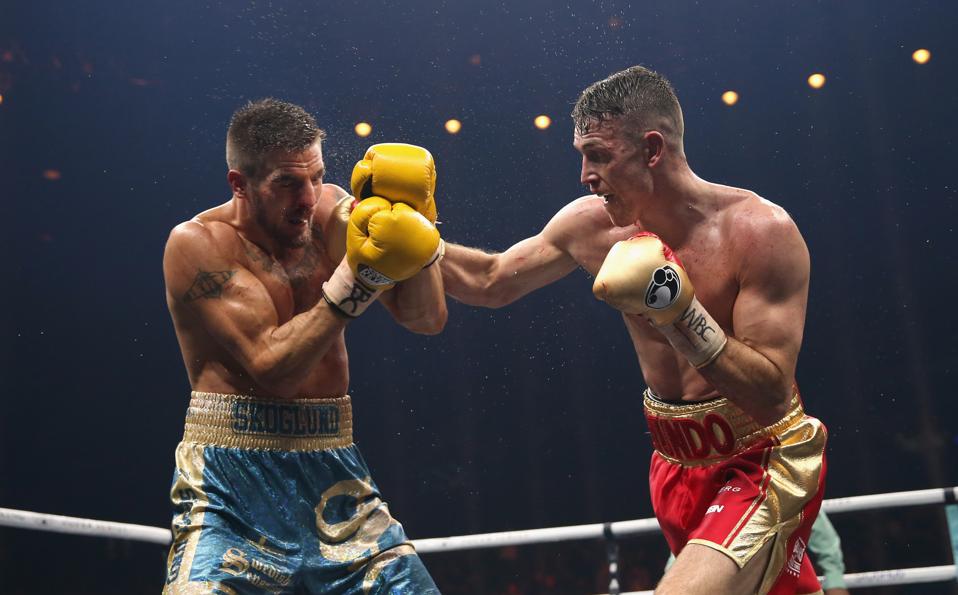
Callum Smith, right, lands a right shot on Erik Skoglund last week in the WBSS. (Photo by Alex Livesey/Getty Images)
But Richard Schaefer, the former CEO of Golden Boy Promotions who now runs Ringstar Sports, is excited about the possibilities the World Boxing Super Series presents. He’s also patient. He can afford to be.
The fighters in the tournament, though they’re not well known in much of the world, are some of the best on the globe in their divisions, and the fact there is $50 million at stake in these tournaments lent immediate legitimacy when it was announced last March. It hasn’t been a perfect beginning to the WBSS, but Schaefer likes where it’s headed.
That includes the Dorticos (21-0, 20 KOs) vs. Kudryashov (21-1, 21 KOs) matchup, which might be the most exciting quarterfinal fight in the cruiserweight division.
"This is the first time that all of the best fighters in the division have been collected in a tournament,” Kudryashov said, “so it is a big opportunity for me.”
It’s a big opportunity for everybody involved. For the cruiserweights, the tournament includes most of the recognized titlists (Oleskander Usyk, Dorticos (who owns a secondary title), Mairis Briedis, and Murat Gassiev). And though the super middleweights event only boasts one beltholder, George Groves, in its tournament, Callum Smith and Chris Eubank Jr. are bankable stars in the U.K. and Rob Brant is the lone American.
Though the first weekend of the tournament was slightly marred by a livestream that couldn’t handle the glut of people who tried to watch Usyk beat Marco Huck, Schaefer says the demand was so great, the livestream couldn’t keep up. In retrospect, it wasn’t a terrible problem to have.
“You live and learn,” Schaefer told Forbes. “I’m not overly concerned about that. This is not about one fight. This about the overall tournament. It’s a long-term strategy. It’s growing pains. But I have to say this is absolutely first class. [The organizers] really believe in building the brand. If you want to maximize in the long term, you need to build the brand. You need to show the quality of the different elements from the fights to the setup to the events and that they can maximize the revenues behind this whole concept. It’s another thing to execute it and make it happen.”
The WBSS is modeled after the Champions League in Europe where the top soccer teams from the various leagues on that continent play in one of the most prestigious events in the world. The idea for the WBSS is to announce new weight classes every May, showcase a draft event where the tournament brackets are set every June, begin the quarterfinals every September or October, conduct the semifinals every January and February, and show the finals every May. Then, the cycle starts all over again with different weight classes.
It’s not a one-off, like the Super Six World Boxing Classic that featured some of the top super middleweights in the world from 2009-2011 but was also beset by injury problems, mediocre replacements and other delays that hurt the integrity of the product. The WBSS is like a boxing season that resets every year, and that kind of consistency should help attract TV programmers and sponsors.
“When the concept was originally presented to me and I was asked to get involved from a strategic point of view and a U.S. point of view, I was skeptical,” Schaefer said. “When I look at the Super Six, that was embraced by the fans because fans like tournaments. One thing leads to another. You have a clear path. You obviously never know about injuries, but you also don’t about that in other sports. You don’t know if the quarterback is going to play in the Super Bowl. But you know, no matter what, the game is going to happen.”
So far, though, nobody can watch that game in the U.S. At one point it seemed that the WBSS and Showtime were close to an agreement for U.S. TV rights, but thus far, no deal has been struck.
“[The WBSS organizers] do not want to rush into commercial deals where they don’t feel it benefits the long-term value of the property,” Schaefer said. “In order to get the right partners and get the right financial package as well, when you start something new, a lot of people are skeptical. If it’s just going to be shown on the [WBSS] website for now, that’s not the worst thing, particularly with the younger demographic. They’re used to watching livestreams anyway. It’s better to do that then get a bad TV deal or get a deal that doesn’t fit into your long-term strategy.”
This first set of tournaments, of course, are important. Not just for the current fighters and their careers but also in convincing promoters and their fighters in other weight classes that competing in a tournament like this make sense.
“It’s going to come down to money and the promoters need to be willing to listen to a structure which would benefit everyone and, most importantly, the sport,” Schaefer said. “Where they don’t feel threatened and they don’t feel like we’re going to take away promotional rights from their particular fighters. As you see this unfold, whoever wins the cruiserweight or the super middleweight tournament, those fighters will go back to their respective promoters. Hopefully, that should give them a level of comfort, and the second time around, it will get easier to attract some of the top talent.
">When Yunier Dorticos takes on Dmitry Kudryashov in San Antonio on Saturday night, it’ll be the third-straight weekend of the World Boxing Super Series. It’s two eight-man tournaments featuring two weight classes that are some of the least glamorous in boxing (the cruiserweights and the super middleweights). It’s a tournament where most of the competitors are unknown in the U.S. It’s a tournament where only one fighter is American, and as of today, it’s a tournament that still doesn’t have a U.S. TV deal.
Callum Smith, right, lands a right shot on Erik Skoglund last week in the WBSS. (Photo by Alex Livesey/Getty Images)
But Richard Schaefer, the former CEO of Golden Boy Promotions who now runs Ringstar Sports, is excited about the possibilities the World Boxing Super Series presents. He’s also patient. He can afford to be.
The fighters in the tournament, though they’re not well known in much of the world, are some of the best on the globe in their divisions, and the fact there is $50 million at stake in these tournaments lent immediate legitimacy when it was announced last March. It hasn’t been a perfect beginning to the WBSS, but Schaefer likes where it’s headed.
That includes the Dorticos (21-0, 20 KOs) vs. Kudryashov (21-1, 21 KOs) matchup, which might be the most exciting quarterfinal fight in the cruiserweight division.
"This is the first time that all of the best fighters in the division have been collected in a tournament,” Kudryashov said, “so it is a big opportunity for me.”
It’s a big opportunity for everybody involved. For the cruiserweights, the tournament includes most of the recognized titlists (Oleskander Usyk, Dorticos (who owns a secondary title), Mairis Briedis, and Murat Gassiev). And though the super middleweights event only boasts one beltholder, George Groves, in its tournament, Callum Smith and Chris Eubank Jr. are bankable stars in the U.K. and Rob Brant is the lone American.
Though the first weekend of the tournament was slightly marred by a livestream that couldn’t handle the glut of people who tried to watch Usyk beat Marco Huck, Schaefer says the demand was so great, the livestream couldn’t keep up. In retrospect, it wasn’t a terrible problem to have.
“You live and learn,” Schaefer told Forbes. “I’m not overly concerned about that. This is not about one fight. This about the overall tournament. It’s a long-term strategy. It’s growing pains. But I have to say this is absolutely first class. [The organizers] really believe in building the brand. If you want to maximize in the long term, you need to build the brand. You need to show the quality of the different elements from the fights to the setup to the events and that they can maximize the revenues behind this whole concept. It’s another thing to execute it and make it happen.”
The WBSS is modeled after the Champions League in Europe where the top soccer teams from the various leagues on that continent play in one of the most prestigious events in the world. The idea for the WBSS is to announce new weight classes every May, showcase a draft event where the tournament brackets are set every June, begin the quarterfinals every September or October, conduct the semifinals every January and February, and show the finals every May. Then, the cycle starts all over again with different weight classes.
It’s not a one-off, like the Super Six World Boxing Classic that featured some of the top super middleweights in the world from 2009-2011 but was also beset by injury problems, mediocre replacements and other delays that hurt the integrity of the product. The WBSS is like a boxing season that resets every year, and that kind of consistency should help attract TV programmers and sponsors.
“When the concept was originally presented to me and I was asked to get involved from a strategic point of view and a U.S. point of view, I was skeptical,” Schaefer said. “When I look at the Super Six, that was embraced by the fans because fans like tournaments. One thing leads to another. You have a clear path. You obviously never know about injuries, but you also don’t about that in other sports. You don’t know if the quarterback is going to play in the Super Bowl. But you know, no matter what, the game is going to happen.”
So far, though, nobody can watch that game in the U.S. At one point it seemed that the WBSS and Showtime were close to an agreement for U.S. TV rights, but thus far, no deal has been struck.
“[The WBSS organizers] do not want to rush into commercial deals where they don’t feel it benefits the long-term value of the property,” Schaefer said. “In order to get the right partners and get the right financial package as well, when you start something new, a lot of people are skeptical. If it’s just going to be shown on the [WBSS] website for now, that’s not the worst thing, particularly with the younger demographic. They’re used to watching livestreams anyway. It’s better to do that then get a bad TV deal or get a deal that doesn’t fit into your long-term strategy.”
This first set of tournaments, of course, are important. Not just for the current fighters and their careers but also in convincing promoters and their fighters in other weight classes that competing in a tournament like this make sense.
“It’s going to come down to money and the promoters need to be willing to listen to a structure which would benefit everyone and, most importantly, the sport,” Schaefer said. “Where they don’t feel threatened and they don’t feel like we’re going to take away promotional rights from their particular fighters. As you see this unfold, whoever wins the cruiserweight or the super middleweight tournament, those fighters will go back to their respective promoters. Hopefully, that should give them a level of comfort, and the second time around, it will get easier to attract some of the top talent.
https://www.forbes.com/sites/joshkatzowitz/2017/09/23/world-boxing-super-series-anthony-joshua-showtime/
0 komentar:
Posting Komentar